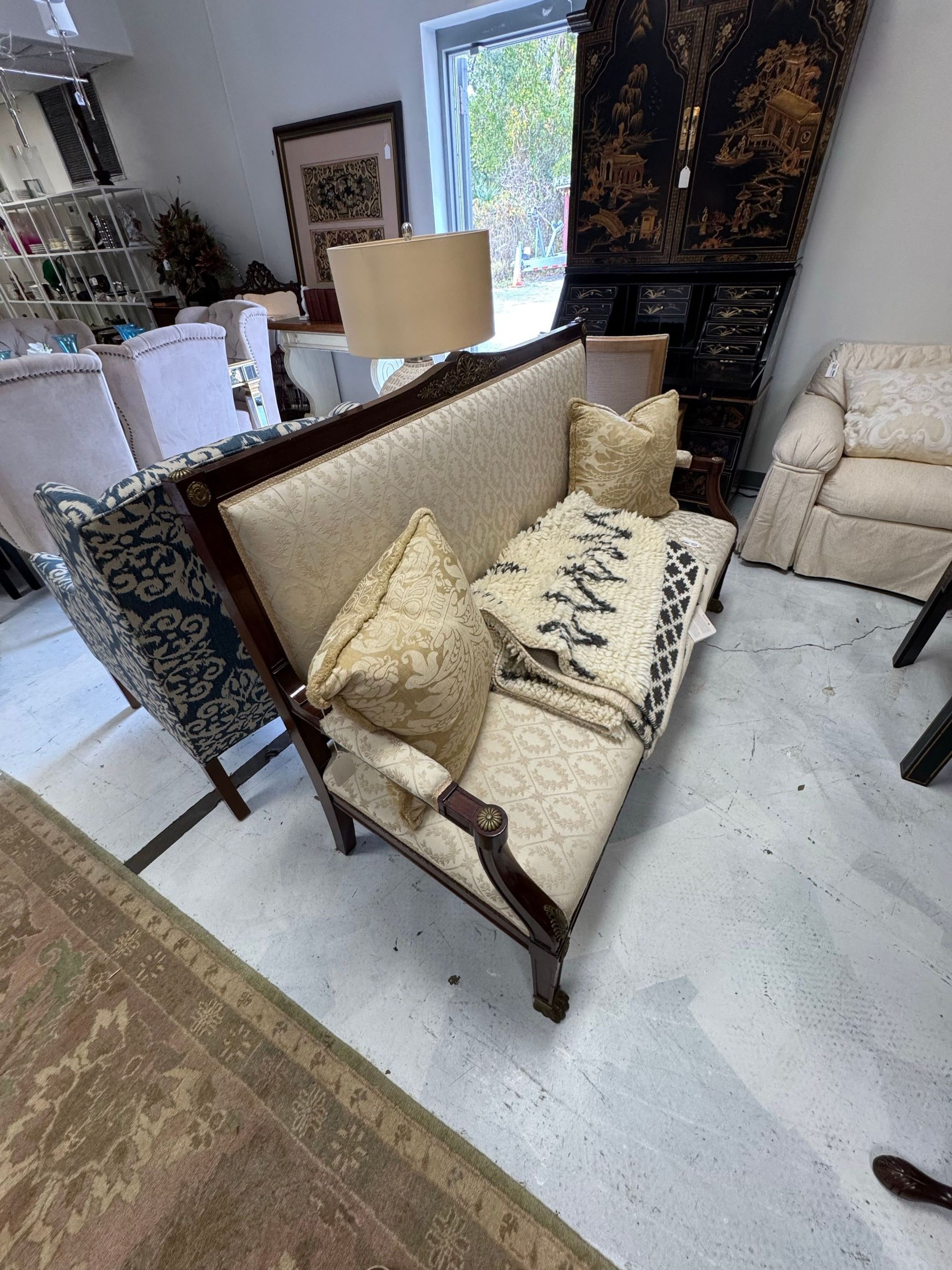
Empire Style Settee with Upholstered Seat and Back
Description
This is an Empire-style settee, characterized by its dark wood frame, likely mahogany or walnut, with carved details and brass accents. The upholstery on the seat and back appears to be a light-colored damask or jacquard fabric with a subtle, repeating pattern of foliage or laurel wreaths. The armrests are elegantly curved, and the overall silhouette suggests a piece from the early to mid-19th century, though it could also be a later reproduction in the Empire style. It is accompanied by two throw pillows, one in a matching damask and another with a more abstract, tribal-inspired pattern. Structural features include carved rosettes at the top of the armrests and fluted or reeded legs that terminate in claw feet. The frame exhibits a polished finish, and the upholstery, while appearing clean, shows some signs of wear consistent with use. The back of the settee has a slightly curved top rail, a common characteristic of Empire furniture, and is upholstered to match the seat. The presence of a throw blanket with a geometric pattern adds a contemporary touch to the piece.
Categories
Stories
- The Empire style, prevalent in the early 19th century, was heavily influenced by Napoleon Bonaparte's reign and drew inspiration from ancient Egyptian, Greek, and Roman design. Key characteristics include bold lines, symmetrical forms, rich woods like mahogany, and decorative motifs such as eagles, laurel wreaths, and classical figures. This style aimed to convey power, grandeur, and imperial authority, and was popular across various forms of decorative arts, including furniture, architecture, and fashion.
- The sofa's design, with its dark wood frame, curved armrests, and symmetrical ornamentation, aligns with the typical features of Empire furniture. While specific attribution is not possible from the image alone, pieces in this style were produced by numerous cabinetmakers across Europe and America during the period. Without visible maker's marks, it's challenging to pinpoint a specific artisan or workshop. However, the overall execution suggests a piece intended to emulate the opulence and formality of the era.