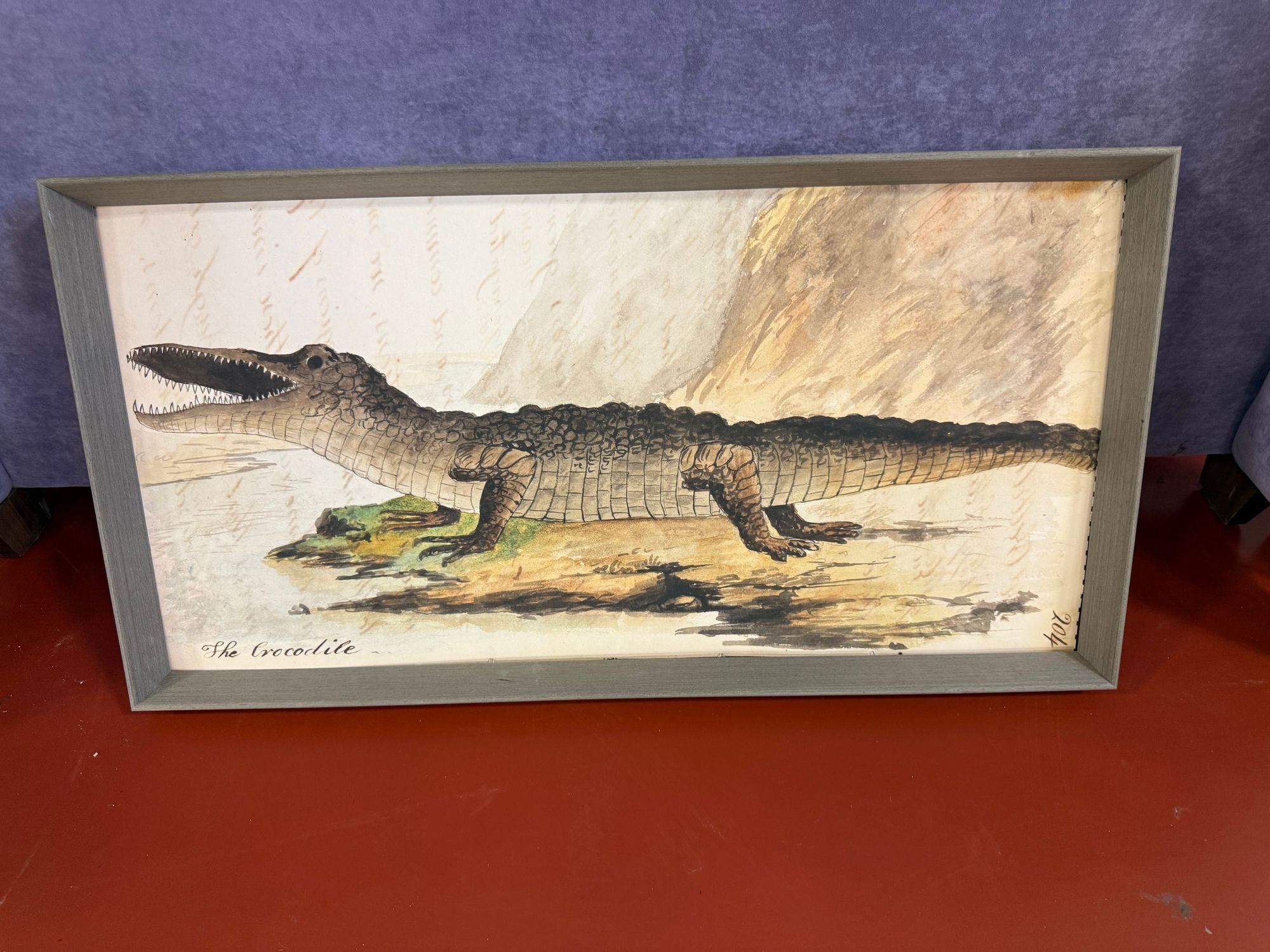
Antique "The Crocodile" Print by John Gabriel Stedman
Description
This is a framed print of an antique illustration titled "The Crocodile." The artwork depicts a crocodile in a naturalistic setting, rendered in a style consistent with 18th or 19th-century natural history illustrations. The print features detailed linework for the crocodile's scales and form, with watercolor washes for the background and water. Faint script text is visible behind the illustration, suggesting it may be a reproduction of a plate from an older scientific or encyclopedic work. The overall aesthetic is that of a vintage educational or decorative piece. The print is identified as being from the work of John Gabriel Stedman, known for his "Narrative of a Five Years' Expedition against the Revolted Negroes of Surinam." The number '204' is visible in the bottom right corner, possibly a plate number.
Categories
Stories
- The depiction of crocodiles and alligators in early natural history texts was crucial for scientific understanding and often fueled public fascination with exotic and dangerous creatures. These illustrations served not only as scientific records but also as educational tools, introducing people to the biodiversity of the world. Early naturalists often relied on specimens brought back from expeditions, leading to artistic interpretations that sometimes blended scientific accuracy with artistic license. The title "The Crocodile" suggests a direct and perhaps primary focus on this animal within its original publication.
- The style of script and illustration suggests a possible origin in the late 18th or early 19th century, a period of significant exploration and scientific documentation. Natural history publications from this era, such as those by Georges Cuvier or early encyclopedias, often featured detailed engravings and lithographs of animals. While the specific artist is not immediately identifiable from the image, the meticulous detail points to a skilled illustrator who was likely familiar with the scientific illustration conventions of the time. The number "204" faintly visible in the lower right corner might be a plate number or inventory mark, which could aid in identifying the original source if further research is conducted.