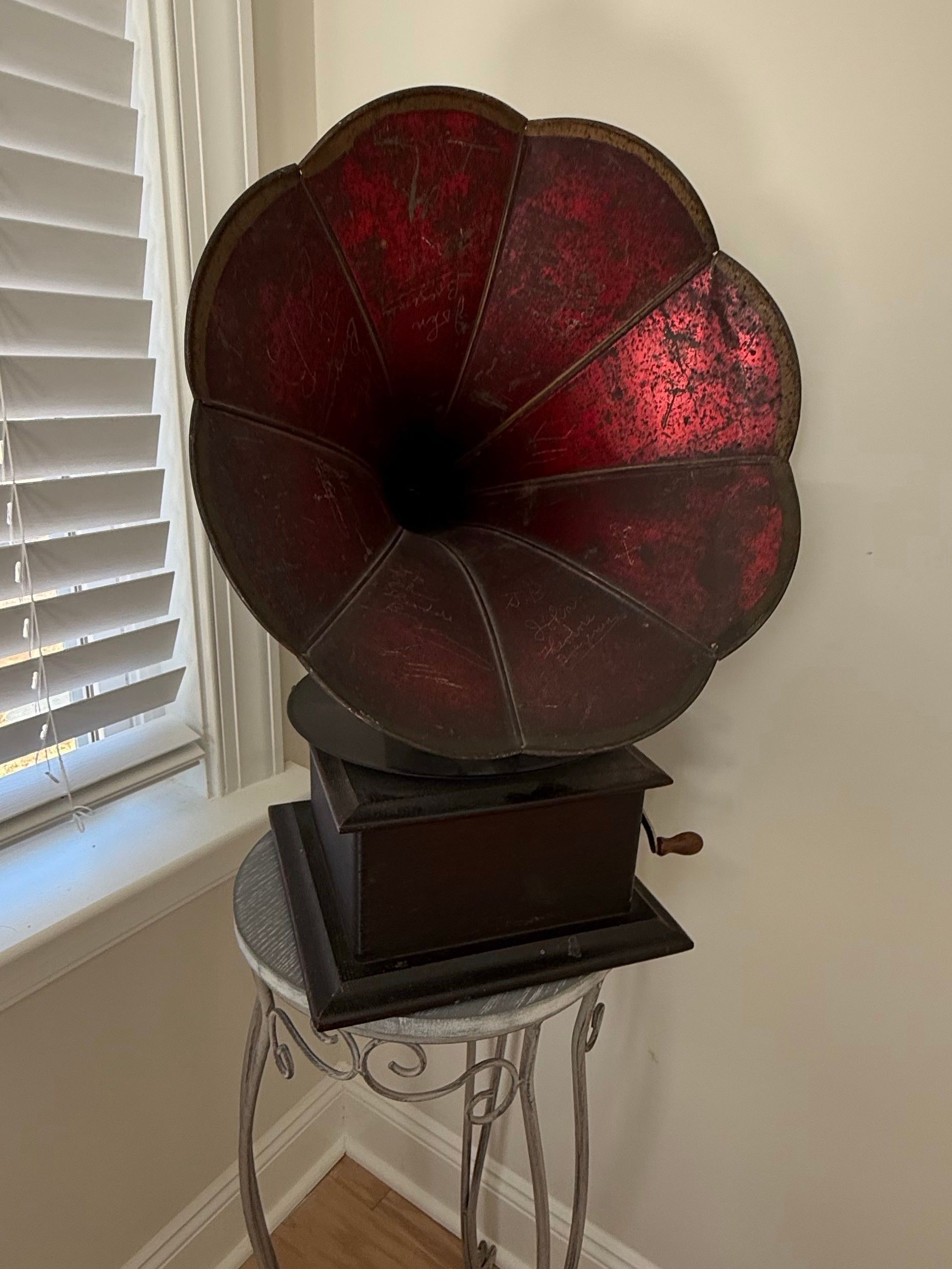


Standard Talking Machine Model A Phonograph
Description
This is a vintage Standard Talking Machine Model A phonograph, likely from the early to mid-20th century. It features a dark wood base housing the winding mechanism and turntable, topped with a large, flared horn in a deep red, metallic finish. The horn is segmented, suggesting a metal construction, and displays some wear consistent with its age. The tonearm and needle assembly are present, ready to play records. The overall aesthetic is characteristic of early sound reproduction devices, serving both as a functional music player and a decorative piece.
Categories
Stories
- The "Victrola" is a trademark name used by the Victor Talking Machine Company for its line of internal horn phonographs. Introduced in 1906, the Victrola revolutionized the way people experienced recorded music. Unlike earlier external horn models, the Victrola housed the horn within the cabinet, creating a more compact and aesthetically pleasing design. This innovation made phonographs more accessible and desirable for home use, leading to their widespread popularity and cementing their place in cultural history. The success of the Victrola was so immense that the name became a generic term for any internal horn phonograph, much like "Kleenex" for tissues.
- Thomas Edison invented the first practical phonograph in 1877, a groundbreaking device that could both record and reproduce sound. Initially, phonographs used external horns to amplify sound, which were cumbersome and less elegant. Edison's company, and later competitors like the Victor Talking Machine Company, continuously refined the design. The development of the internal horn phonograph, exemplified by the Victrola, was a significant leap forward, making the technology more user-friendly and attractive for domestic settings. These machines represent a pivotal moment in the history of entertainment and mass media, ushering in the era of recorded sound for the masses.